
Use the Docking Station Finder to match your laptop to the right dock in under 60 seconds. Most dock buying mistakes come down to three mismatches: wrong protocol, wrong power delivery, wrong display support. This tool eliminates all three.
Answer 5 questions → get a matched dock recommendation instantly.
What’s your setup?
This determines which docks are compatible with your ecosystem.
Your Dock Recommendations
Based on your setup, here are the best options.
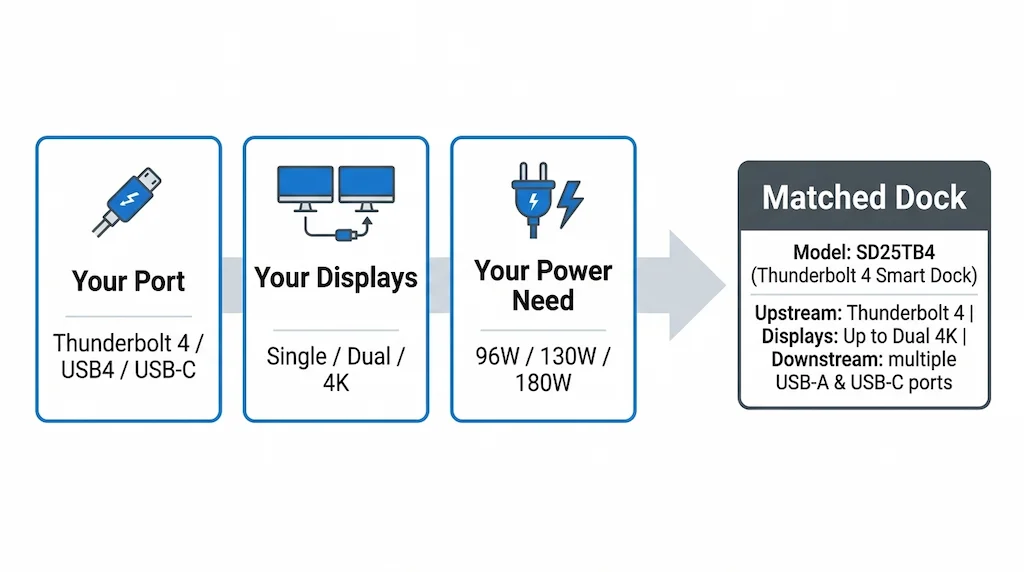
What the Docking Station Finder Checks Before Recommending a Dock
Thunderbolt 4 vs USB4 vs USB-C — What Your Port Actually Supports
Not all USB-C ports are equal. A port must support DisplayPort Alt Mode to output video. It must support Thunderbolt 4 or USB4 to run a full-bandwidth docking station. Data-only USB-C ports — common on budget laptops and secondary ports — will cause detection failures and constant disconnects regardless of which dock you buy. Check your laptop’s spec sheet for a ⚡ symbol or “Thunderbolt 4” label on the port.
Display Requirements — Single, Dual, and 4K Setups
Display support is where most buyers get burned. Dual monitors require MST (Multi-Stream Transport) — a feature Windows supports natively but base Apple Silicon Macs (M1, M2, M3) do not. 4K@60Hz requires HBR3 bandwidth, which not all docks deliver reliably on both outputs simultaneously. Match your display count and resolution before selecting a dock — not after.
Power Delivery — Why Wattage Matters More Than You Think
An underpowered dock charges your laptop at reduced rates under load — or not at all. For standard 15-inch laptops: 96W minimum. For high-performance machines: 130W or higher. A dock delivering 65W to a laptop that needs 100W will brownout under combined display and peripheral load, causing random disconnects that look like a faulty dock but are actually an underpowered one.